


Branch vs Subsidiary in the Republic of Moldova
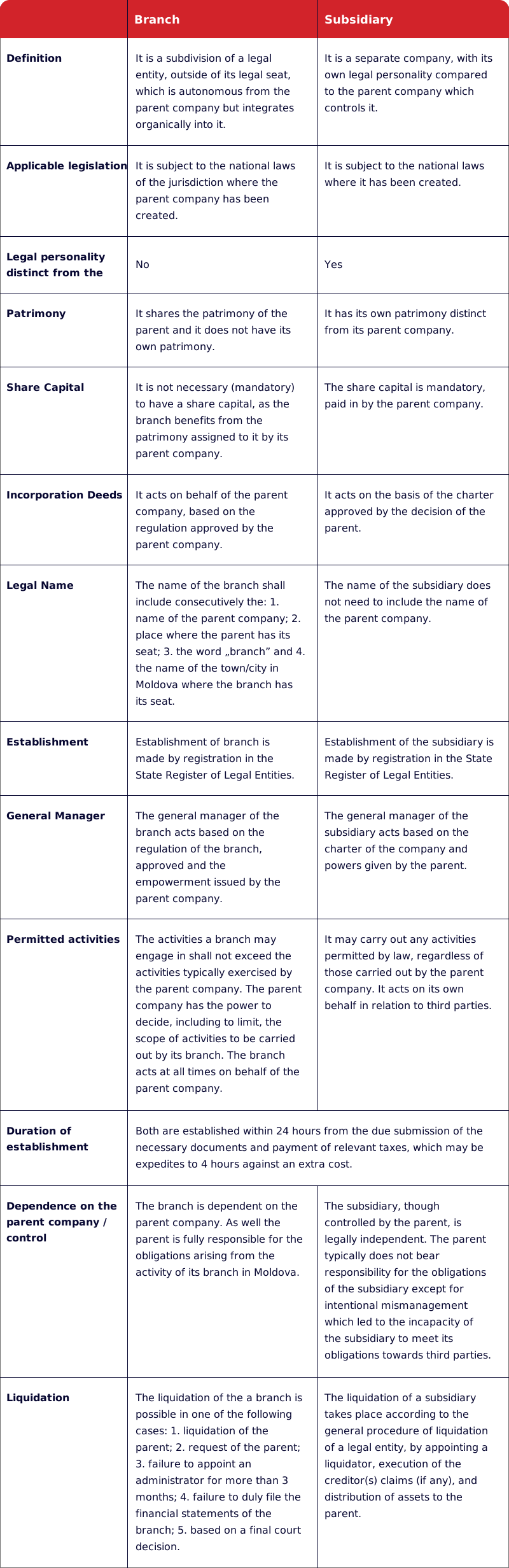
The main corporate structures in Moldova are the branches and the subsidiaries. Starting with 1 March 2019[1], the national legislation, among others, regulating these corporate structures were adjusted in line with the European Union legislation and the principles set by the Association Agreement between the Republic of Moldova and the European Union of 27 June 2014. Thus, the new regulations state that a branch has no legal personality being a subdivision of a legal entity (parent). At the same time, the subsidiary while being controlled by another legal entity (parent), has separate legal personality.
The concept of the representative office as a corporate structure has been abandoned and maintained only for tax purposes (permanent establishment)[2].
Thus, the new regulations provide for certain novelties in the national company law, such as additional protection of the subsidiary from the insolvency of the parent company, amended rules of licensing applied to subsidiary/branch (in case the parent company has already been issued a license) and setting dimensions of extension of jurisdiction.
Below, you may find a brief comparison of the these two forms, focusing mainly on the creation, operation and closing of these forms of doing business in Moldova.
[1] Law no. 133 of the modernization of the Civil Code and of the modification of some legislative acts of 15.11.2018 (“Law 133/2018”) entered into force on 01.03.2019
[2] For more details regarding this topic, please follow the link: /2018/02/05/operation-through-permanent-establishment-in-moldova/
Authors: Cristina Martin, Partner, PhD and Nicolina Turcan, Associate

ACI Partners
Latest Posts
 by office
Legal Monitoring Report for January 2026
The January 2026 Legal Monitoring Report highlights key legislative developments, including Amendments to the Tax Regime Applicable to Independent...
by officeLegal Expert Review: Moldova’s New Personal Data Protection Law
The new legislation substantially transposes Regulation (EU) 2016/679 (the “GDPR”) and constitutes one of the most far-reaching legislative reforms...